
The Real Reason AI Won't Transform Most Organizations
Every few years, organizations chase a new promise.
Cloud computing would transform the business. Big data would transform the business. Agile would transform the business. Now, artificial intelligence will transform the business.
The pattern is familiar. A new technology emerges. Vendors position it as the next competitive advantage. Executives feel pressure to act. Roadmaps are built, platforms are purchased, initiatives are launched, and organizations begin moving quickly toward implementation.
But speed is not the same as transformation.
After nearly two decades working at the intersection of data, analytics, AI, technology, and organizational change, I've come to believe many transformation efforts struggle for a simple reason: organizations move too quickly from problem to product.
They recognize a legitimate business challenge, but instead of slowing down long enough to understand the conditions required for change, they select a technology and expect the organization to transform around it.
That rarely works. Technology can accelerate transformation. It cannot create alignment where alignment doesn't exist.
The Pattern I Saw Early in My Career
Early in my career, I watched this pattern play out in a way that shaped how I think about transformation.
The organization was facing a real challenge. Data volume was growing rapidly, and the systems we relied on were beginning to strain under the weight of it. Leadership was right about one thing: the organization needed to think differently about data. But the conversation moved too quickly from problem to product.
At the time, Hadoop was being promoted across the industry as the answer to "big data." It promised scale, flexibility, and a modern foundation for analytics. The assumption became that adopting a Hadoop-based platform would modernize the organization's data capabilities.
What followed was familiar to anyone who has lived through a technology-led transformation.
The project experienced repeated delays. Costs increased. The internal team was being asked to move from a relational database mindset to a file-based big data architecture without the organizational readiness required to make that shift. Over time, leadership began questioning whether the expected return justified the continued investment. Eventually, the answer was no. The initiative was abandoned.
Looking back, I don't believe the core issue was that Hadoop had no value. The issue was that the organization had invested in a technical direction before it had aligned the business problem, the operating model, the skills required, and the path to adoption.
The technology may have been capable. The organization wasn't ready to create value from it. That distinction matters.
What Changed
New leadership was put in place, and the approach changed. The new leader did something simple but powerful: he listened. Rather than assuming the next answer needed to come from another major platform decision, he created space for the staff closest to the work to bring solutions forward.
What emerged was not as flashy as the original Hadoop vision, but it was far more executable.
For some needs, the team used Microsoft Report Writer, built on top of simple, understandable data models that could deliver value quickly. For larger and more complex datasets, the organization introduced Data Vault modeling — a more scalable way to structure data that still fit the team's existing skills and the business's actual maturity level. Neither choice was cutting-edge. Both were within reach of the team that had to run them, which is precisely why they worked where the more ambitious platform hadn't.
But the technology choice was only part of the story. The real difference was leadership.
The new leader believed the people closest to the problem could help define the solution. He trusted the team's judgment. He created room for practical ideas to compete with more glamorous ones. And because the solution aligned with the business need, the team's capability, and the organization's operating reality, it succeeded where the larger initiative had failed.
The result was straightforward but significant. Data began to become information. It moved faster into the hands of people who could interpret it, trust it, and act on it. Quality improved. Usability improved. The organization's confidence in its own data improved.
That is when transformation started — not when a new platform was selected, and not when a technology roadmap was approved, but when people across the organization could use data to understand the business more clearly and make better decisions.
The Transformation Alignment Model
That experience reinforced a belief that has shaped my leadership ever since: transformation doesn't happen when one thing changes. It happens when the right things move together.
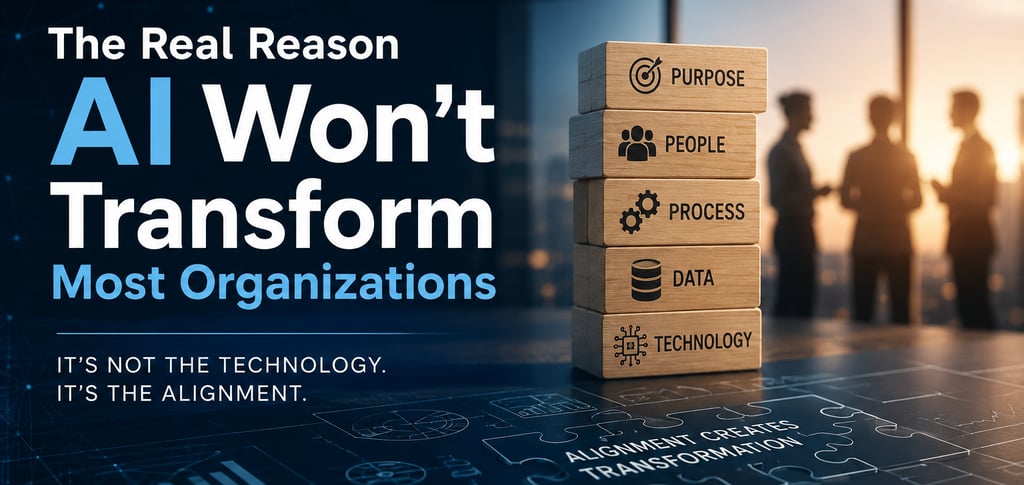
I've come to think about this through five alignment points. I didn't start with these five and work backward to make them sound tidy — they're the five places I've seen almost every failed initiative I've been part of actually break down, regardless of which technology was involved:
Purpose — What outcome are we actually trying to create?
People — Who needs to understand, trust, use, support, and sustain the change?
Process — What workflows, decisions, behaviors, and operating rhythms need to change?
Data — What information must be structured, trusted, governed, and actionable?
Technology — What tools best enable the outcome?
When those five elements move together, technology becomes a powerful accelerator. When they don't, technology often becomes an expensive distraction.
The mistake many organizations make isn't investing in technology — that investment is necessary. The mistake is letting technology move faster than purpose, people, process, and data.
That is when transformation starts to break down. The organization may be busy. The roadmap may be active. The budget may be approved. The implementation may even be technically successful. But if the people aren't prepared, the processes aren't ready, the data isn't trusted, and the purpose isn't clear, the organization hasn't transformed.
It has simply installed something new.
AI Is Exposing the Same Mistake
Artificial intelligence is now creating the same risk at a much larger scale.
One of the most common mistakes I see is the assumption that all AI is essentially the same. In many executive conversations, "AI" has become almost synonymous with large language models. That oversimplification matters, because it collapses a broad field of technologies, methods, use cases, risks, and operating requirements into a single category.
That leads to a second mistake: believing AI can simply do what humans do, only faster. There's some truth in that, but it's incomplete. AI can summarize, classify, generate, predict, recommend, and automate in powerful ways. But it doesn't understand an organization the way experienced employees do. It doesn't carry institutional context. It doesn't know which assumptions matter, which exceptions are meaningful, which relationships are fragile, or which decision might create unintended consequences six months later.
I've seen what this looks like in practice. Picture a support organization that feeds years of past ticket resolutions into a model to automate first-response answers. The historical data looks clean — thousands of resolved tickets, clear categories, high closure rates. What the data doesn't show is that a meaningful share of those resolutions were themselves workarounds: inconsistent, undocumented, or outright wrong fixes that happened to close the ticket without actually solving the underlying problem. A model trained on that history doesn't know the difference between a genuinely good resolution and a bad one that simply got the customer to stop calling. It learns to automate the pattern, not the judgment behind it — and it does so at a scale and speed no individual agent ever could. The organization doesn't get faster support. It gets confidently wrong support, faster.
That is where leadership matters. That is where data governance matters. That is where organizational context matters.
Without people who know the right questions to ask, data structured with the right semantics and governance, processes designed for adoption, and technology implemented around real business outcomes, much of AI's potential remains out of reach — or worse, gets deployed against exactly the wrong foundation.
The danger isn't simply that organizations will buy the wrong AI tool. The danger is that they'll mistake access to AI for readiness to transform with AI. AI doesn't eliminate the need for organizational alignment. It increases the cost of not having it.
A Fair Counterpoint
It would be easy to take this argument too far and say technology doesn't matter. That's not what I believe. Technology matters tremendously, and leadership alignment has real limits.
Consider a company running critical workloads on a mainframe platform a vendor has announced it will stop supporting within eighteen months. Every team can be perfectly aligned on purpose, fully bought in, well-trained, and working from clean, trusted data — and none of that changes the fact that the platform is going away. No amount of listening to frontline staff rewrites a vendor's end-of-life timeline or gives a legacy system the throughput a modern AI workload requires. In cases like this, the technical constraint is real and binding, and alignment alone doesn't solve it. The organization has to modernize the infrastructure first, on a timeline the technology itself dictates, before alignment can do any of its usual work.
So I'm not arguing leadership is sufficient on its own. I'm arguing it's the precondition that determines whether a technology investment — necessary or not — actually produces value once it's in place. The mainframe still has to be replaced. But whether the replacement succeeds still depends on whether purpose, people, process, and data are ready to make use of it.
The strongest transformations aren't technology-led or people-led in isolation. They're leadership-led, with technology, data, process, and people aligned around a clear purpose. That distinction matters because it keeps leaders from falling into either extreme — the belief that technology alone will solve the problem, or the belief that culture and leadership are all that matter. The truth is harder than either, but more useful: organizations transform when leadership creates the conditions for technology to produce value, including recognizing the moments when the technology itself is the binding constraint.
The Real Lesson
When I look back on the transformations that worked, the common thread is rarely the tool itself. It's the alignment created around the tool.
The best leaders don't start by asking, "What technology should we implement?" They ask better questions first: What problem are we really trying to solve? What outcome matters? Who needs to be involved? What decisions are we trying to improve? What data must be trusted? What processes need to change? What capabilities do our people need to build?
And only then: What technology best enables that future?
That sequence matters. Once an organization starts with the tool, every other question becomes secondary. When an organization starts with purpose, technology can finally serve its proper role. It becomes an amplifier — not the transformation itself.
The failure in that early data initiative wasn't that the organization recognized a growing data challenge. The failure was assuming a technology trend could solve it without the necessary alignment around purpose, people, process, and data. The success that followed came from leadership trusting the people closest to the problem, choosing solutions the organization could actually execute, and focusing on turning data into information people could use.
That is the work that creates transformation. Not technology alone. Not strategy alone. Not culture alone. All of it moving together.