
The Boat Is Gone. The Ripples Remain.
Leadership choices rarely end in the moment. Like ripples across a lake, they continue shaping trust, behavior, and culture long after the leader has moved on.
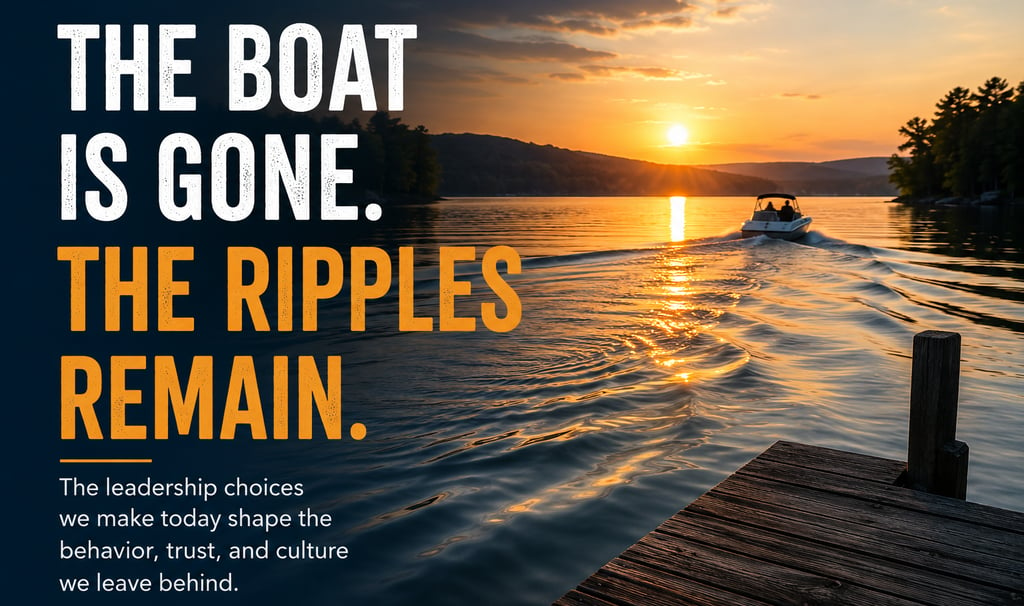
This weekend, I was sitting on the dock at Smith Mountain Lake with my family. We'd rented a cabin for the week, and as the sun dropped low over the water this evening, the lake had gone quiet. No boats in sight. No motors running. Just stillness.
And then the waves arrived.
They rolled in gently, one after another, lapping against the dock long after the boat that caused them had disappeared around the bend. Whoever had been driving that boat was probably tying up somewhere, unloading coolers, already thinking about dinner. They had no idea their wake was still moving across the water, still reaching the shore, still shaping the surface of the lake.
I remember thinking: that's exactly what leadership is like.
We make a decision, have a conversation, react to a mistake, and then we move on to the next thing. The people affected by that moment don't move on nearly as fast. The impact keeps traveling long after we've stopped paying attention to it.
Here's the sharper version of that thought, the one I keep coming back to: the real measure of a leadership choice isn't just the outcome it produces today. It's the behavior it teaches other people to repeat tomorrow.
Leadership Is Never Neutral
Leaders don't get to choose whether they have an impact. They only get to choose what kind of impact they have.
Most of the moments that matter don't feel like defining ones. A quick response to an email. A comment in a meeting. The way we react when someone tells us something went wrong. None of it feels significant in the instant it happens. It just feels like Tuesday. But the person on the other side of that interaction carries it with them, deciding, often without realizing it, what kind of behavior is safe to repeat and what kind is better left hidden.
Even silence sends a message. Say nothing when someone cuts a corner, and you've said something. What we tolerate can shape a team just as powerfully as what we actively promote, and it doesn't require a title. Anyone whose behavior shapes another person's confidence or willingness to speak up is creating ripples, whether they intend to or not.
Early in my career, I worked for a leader who understood this better than almost anyone I've met since.
When a Familiar Phrase Becomes a Leadership Practice
She used to say, "Failing is just another opportunity to learn." It's not an unusual thing to say. What made her different wasn't the phrase. It was that her actions matched it.
I remember one project where we'd misread a client's requirements and delivered the wrong version of a deliverable, days before it was due. It was the kind of mistake that usually gets buried in a quiet correction and never discussed again. Instead, she brought it up in our next team meeting, by name, and asked one question: "What did we learn about how we gather requirements?" Not who missed it. Not how bad the fallout was. Just that. We spent twenty minutes rebuilding our intake process so it wouldn't happen the same way twice, and by the end of the conversation, the mistake felt less like something to hide and more like something we'd used.
That was the pattern. She didn't just permit failure behind closed doors. She made it a visible, shared part of how the team operated, and over time that changed three things: people disclosed problems earlier instead of hoping they'd resolve on their own, feedback stopped feeling like an attack, and the team got noticeably faster at adjusting because we weren't spending energy hiding things.
The most important thing she gave us wasn't the lesson from any single mistake. It was the culture that formed around how mistakes got handled, week after week. That culture didn't end when I left that team. It became part of how I lead now.
What I Inherited, and What I Changed
I still think about that experience regularly, and it shows up in how I try to lead. People sometimes call this "fail fast," but I've learned to be careful with that phrase. On its own, it can suggest speed without responsibility, or tolerance for mistakes that were entirely avoidable. It's incomplete unless it's paired with reflection and changed behavior. So here's the standard I actually hold:
Failure is accepted.
Honesty is expected.
Reflection is necessary.
Growth is required.
Repeating a failure without attempting to learn from it is not acceptable.
That last point needs a qualifier. Repetition isn't always a matter of someone simply not caring. Sometimes it points to unclear expectations, weak systems, or gaps in training. The real distinction isn't first failure versus second failure. It's whether the failure was followed by honest reflection and some attempt to adjust. When it isn't, repetition becomes a matter of accountability. When it is, and the mistake still recurs, that's a different, more systemic problem worth solving.
None of this works, though, without safety. Safety is what makes real accountability possible. People only reveal what actually happened, examine it honestly, and commit to improving when they trust that doing so won't be used against them. Psychological safety and accountability aren't opposites. One creates the conditions for the other.
Judge the Choice by the Behavior It Teaches
It's easy to stay focused on the task directly in front of us. Execution matters. But staying locked onto the immediate problem narrows our field of vision until we only see today's result, not what that result sets in motion.
Before moving to the next decision, I try to ask a few questions:
What behavior did this decision encourage?
What did people learn from how the situation was handled?
Did it increase or reduce trust?
What future behavior might this choice produce?
Solving today's problem is execution. Understanding how today's decision shapes tomorrow's behavior is leadership.
That question — what future behavior might this choice produce — is really the whole argument. A single conversation might influence one person. Repeated conversations establish expectations. Expectations shape behavior. Behavior, over time, becomes culture: the accumulated memory of what a leader repeatedly rewards, tolerates, and models, still operating whether or not that leader is in the room.
None of this means leaders can predict every consequence of a decision. Ripples travel further than intent does, and sometimes a well-meant choice produces an effect no one saw coming. That's exactly why it's worth looking for them instead of assuming good intentions were enough.
Look for the Ripples
Most of what feels urgent today will fade faster than we expect. Projects end. Strategies get replaced. But the impact we have on people tends to stay, showing up in how they handle their own failures, their own hard conversations, their own teams, long after we're no longer watching.
Back at the lake, the waves kept arriving long after the boat was gone. Our conversations, our decisions, our reactions work the same way. So before rushing to the next task, it's worth pausing to ask: what impact is this choice creating, and is it the impact I intend to leave behind?
The boat eventually disappears from view.
The ripples continue.