
Executive Consensus Isn't Built on Simplicity—It's Built on Translation
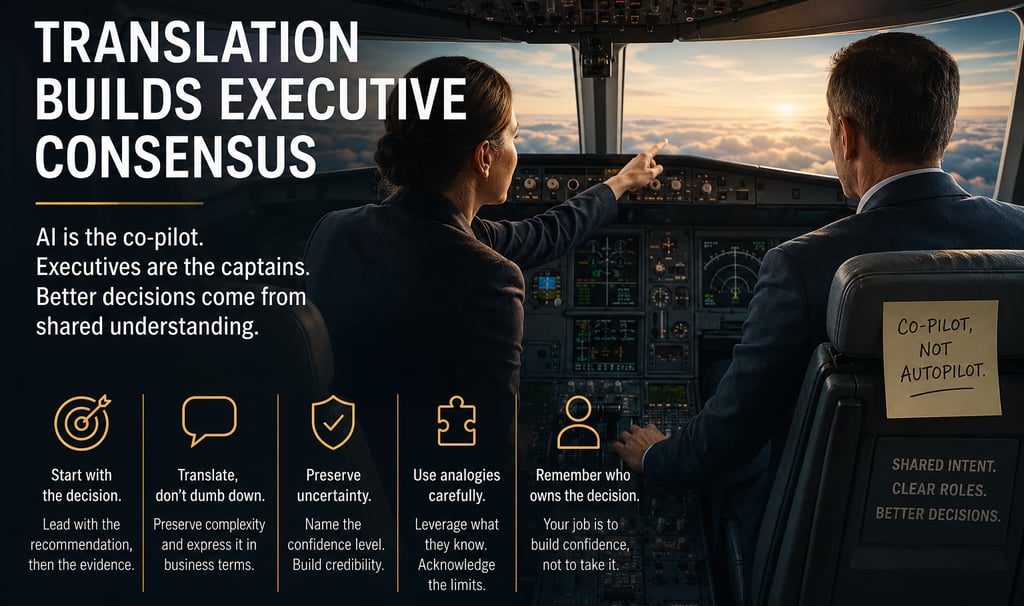
AI isn't the autopilot. It's the co-pilot. The executive is still the captain — setting direction, owning accountability, making the hard calls. That one reframe did more to build executive buy-in on AI than any slide I've ever presented. I wrote about why executive consensus isn't built on simplifying the technology — it's built on translating it into stories executives already know how to trust.
AILEADERSHIP
You've spent weeks preparing the perfect presentation. The architecture is sound. The ROI model is solid. Every technical question has an answer.
Then comes the executive meeting.
No one objects.
No one approves.
Instead, you hear:
"I'd like to understand this a little better."
At first glance, it feels like the presentation failed.
It didn't.
The executives aren't asking for more slides. They're asking for confidence.
It took me years to realize I wasn't presenting technology—I was helping executives make a decision. That's the job for any technical leader who regularly briefs senior executives, and it's a different job than the one most of us were trained for.
The Real Problem Isn't Complexity
Executives aren't short on information. They're short on interpretation.
Most technical leaders assume the fix is simplification, so they strip out nuance and remove uncertainty—the very caveats that made the work rigorous in the first place. Ironically, this creates less confidence, not more.
That's because when uncertainty is high, executives don't lean harder on the spreadsheet. They lean on judgment, pattern recognition, and narrative—the same instincts that got them into the room in the first place. A wall of technical detail doesn't reduce their uncertainty; it just moves it somewhere less visible. A room that hesitates isn't a room that failed to understand the technology. It's a room that hasn't yet been given a reason to trust it.
If simplification isn't the answer, what is?
Executives Don't Need Simpler Technology—They Need Better Translation
There's a real difference between simplifying and translating. Simplifying removes complexity. Translating preserves it, and expresses it in terms an executive can act on—the technical truth stays intact, but the business meaning becomes legible.
Oversimplification sounds like this:
"AI automates work."
Translation sounds like this:
"AI is becoming a trusted teammate that helps professionals make better decisions."
This is the work of strategic compression: distilling complexity into its business implications without cutting the complexity that actually matters. It's a form of sensemaking, the process by which leaders build a shared mental model before asking anyone to commit to a decision. Organizational theorist Karl Weick put it well: executives don't seek perfect descriptions of reality. They seek plausible, shared understanding—something coherent enough that a group of people can coordinate action around it.
I didn't fully understand what that looked like in practice until one presentation permanently changed how I brief executives on AI. It wasn't a better chart or a cleaner deck. It was a story about learning to fly.
The Cockpit Changed Everything
A few weeks ago, I was introducing an Executive AI Literacy program to a leadership team.
I could have opened with large language models, prompt engineering, retrieval-augmented generation, or agentic architectures. All accurate. All technically necessary. All guaranteed to lose the room in the first ninety seconds.
Instead, I started talking about learning to fly.
I walked them through a cockpit—the controls, the throttle, the yoke. I asked them to picture the first time a new pilot sits in that seat, surrounded by instruments that all seem to demand attention at once.
Then I got to the point that mattered.
Most people assume AI is the autopilot. I don't think that's right.
AI is the co-pilot.
The executive is still the captain. The captain sets direction, owns accountability, and makes the difficult calls when conditions change. The co-pilot helps navigate—reading instruments, flagging risk, handling workload so the captain can focus on judgment instead of noise.
Agentic AI is what happens when that co-pilot starts handling entire tasks under the captain's intent, rather than waiting for instruction on every step.
Every analogy has limits, and pretending otherwise undercuts the trust you're trying to build. A real co-pilot can take command if the captain is incapacitated. AI cannot. Naming that limit out loud, rather than hoping no one notices it, is part of what made the room trust the rest of the story.
That cockpit became the most memorable ninety seconds of the entire program. Months later, executives were still using "co-pilot, not autopilot" as shorthand in their own conversations about the initiative.
Why This Worked
The analogy worked because the executives already had a mental model. They understood cockpits, captains, and shared responsibility long before they understood transformer architectures.
Structure-mapping theory explains part of it: people learn unfamiliar concepts by transferring relational patterns from something familiar, not by absorbing new facts in isolation. The value wasn't the surface details of the cockpit—it was the relationship between captain and co-pilot, which maps cleanly onto the relationship between executive and AI.
Narrative transportation explains the rest: stories lower resistance and improve retention in ways bullet points rarely do. A room resists a claim. A room leans into a story.
Put together, that's the "aha" moment for a lot of technical leaders: you weren't communicating badly. You were speaking a different language than the room needed. Translation, not simplification, is what closes that gap.
Building Executive Consensus: A Practical Playbook
1. Start with the decision, not the architecture. Lead with the recommendation, then support it with evidence—the same top-down structure behind consulting frameworks like the Minto Pyramid Principle. Instead of "here's how the model works, and here's what it means," open with "here's what I recommend we do, and here's why."
2. Translate. Never dumb down. "AI automates work" is a simplification. "AI is becoming a trusted teammate that helps professionals make better decisions" is a translation. Same technology, same underlying accuracy—one just gives the room something to act on.
3. Preserve uncertainty. Don't sand down "we're 80% confident in this projection" into "this will work." Say the 80%. Executives can tell the difference between confidence and false certainty, and they trust the leader who names the gap.
4. Use analogies carefully. Choose systems the room already understands, then say out loud where the analogy breaks down—the way a co-pilot can't actually take command of the plane. That one sentence of honesty is often what makes the rest of the story credible.
5. Remember who owns the decision. Executives don't need to become engineers. They need enough clarity to make the call that's actually theirs to make. Your job is to build that confidence—not to transfer your expertise wholesale.
Conclusion
Remember that executive meeting from the beginning—the one where no one objected, and no one approved?
It wasn't a communication failure. It was a translation problem.
The best technical leaders don't simplify the technology—they translate it into a story executives already know how to trust.
That skill will matter as much for cybersecurity, cloud transformation, and digital modernization as it does for AI. The technology in front of you will keep changing. What won't change is this: your job was never to make executives understand the technology. It was to help them decide with confidence.